

(2019 vs 2026 Update)
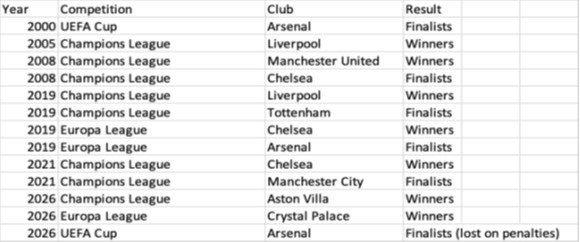
In 2019, just after Britain voted to leave the European Union, I wrote an article about the success of the football team, as English clubs were all four finalists in Europe’s two top cup finals – a feat that had never been done before. And here we are seven years on, and English football clubs have repeated that feat.
English Premier League football has remained successful and become more global and richer than ever. The UK economy, however, has not nearly done as well as its football clubs since leaving the EU. Indeed, the economy has not really recovered from the shocks it has faced over the last eight years (Pandemic, war in Ukraine and the current crisis in the Middle East). Hence, it is useful to reprise the conclusions of that 2019 article and compare them to where we are today.
A new golden era
2019 version:
An astonishing thing happened a few weeks ago. English clubs made up all four finalists in Europe’s top two cup finals. That’s a feat that’s never been done before or since.
2026 update:
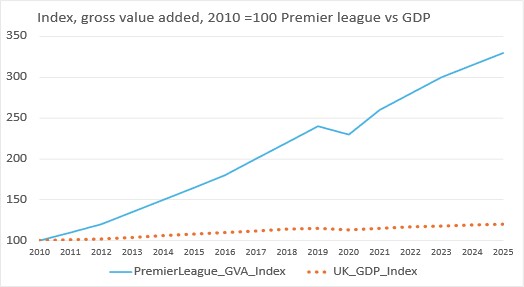
Aston Villa’s victory in the UEFA Europa League and Crystal Palace’s Conference League triumph this season show that English clubs remain dominant in Europe. Arsenal also reached the UEFA Champions League final, losing narrowly on penalties – another reminder of the depth and competitiveness of English football. The Premier League is now the most-watched sports competition on the planet, with a global audience of 1.9 billion and average attendances of over 40,000 per match. It generates nearly £10bn a year in gross value added, contributes £4.4bn in tax revenues, and supports more than 104,500 jobs nationwide. Its global reach and financial muscle are unmatched, even as England’s national team still searches for a senior trophy.
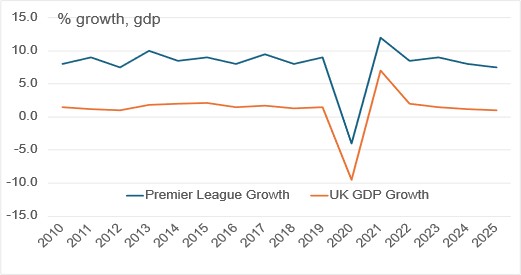
This contrast is striking. In 2019, the ‘all-English finals’ were seen as a one-off golden moment. By 2026, English clubs winning Europe’s top two competitions in the same season has become another chapter in a sustained era of dominance, see table 1. The Premier League has now become Britain’s most successful global industry in terms of value added and growth, see charts 1 and 2.
Football shows the success of globalisation
2019 version:
The answer lies in the economics of globalisation: a global economy creates an opportunity for firms and households to benefit from worldwide economies of scale.
2026 update:
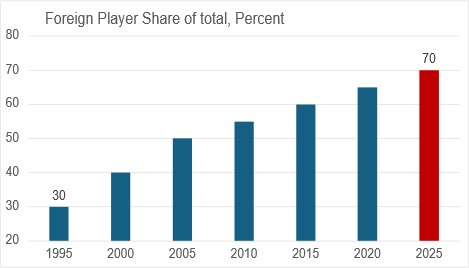
The Premier League has doubled down on globalisation. Nearly 70% of players are foreign-born, and most clubs are owned by overseas investors. American consortia, Emirati sovereign wealth funds, and Saudi investors have poured billions into English football infrastructure. Streaming platforms beam matches to billions worldwide, while foreign capital has transformed stadiums, training grounds, and even city districts. Fans embrace this openness because it delivers excellence.
Globalisation has not only reshaped the Premier League but also the cities around it. Manchester’s Eastlands district, transformed by Emirati investment in Manchester City, is a case study in how foreign capital can regenerate communities. London’s clubs, owned by American billionaires, have become global brands. Football shows that openness can be a source of renewal – or even necessary for success – in an industry that competes globally.
Economic gains of openness
2019 version:
Selling the Premier League to a worldwide audience has made Manchester United the richest club in the world.
2026 update:
Today, broadcasting rights are worth over £5bn across three seasons, and football tourism adds £2.4bn annually to the UK economy. Clubs like Manchester City and Liverpool are global brands, but so too are Aston Villa and Crystal Palace after their European triumphs. Merchandise sales, sponsorships, and digital streaming revenues have created a virtuous cycle: talent attracts success, success drives revenues, revenues fund reinvestment, and reinvestment attracts more talent.
The Premier League’s economic footprint rivals major manufacturing sectors. It is a case study in how openness generates productivity gains. Britain’s wider economy, by contrast, has struggled with stagnant productivity and weak investment. Football demonstrates what happens when barriers are lowered and competition is embraced.
Global talent & freedom of movement
2019 version:
Of the 44 players in the semi-final, only eight were born in England. Of the 12 goals only 1 was scored by an Englishman. The foreign-born players were as committed to the club’s success as were its domestic players.
2026 update:
Today, nearly 70% of Premier League players are foreign-born, and most clubs are owned by overseas investors. Yet fans embrace them because what matters is performance, not passport. Diversity has raised standards, spread best practice, and made English football the world’s benchmark. Foreign managers have introduced tactical innovations, while overseas players have raised the technical level of the game.
This is perhaps the most powerful lesson. Football fans do not seem to care that much about where their heroes come from; they seem to care more about results. Diversity is celebrated because it delivers obvious excellence and positive outcomes for all. Britain’s economy could learn from this: skilled migrants and foreign investors can be seen as assets. Although it could be that it’s harder to draw that lesson from the wider economy than it is from a single discrete sector where the results are so obvious, compared to others that are more opaque, and open to partisan political manoeuverings.
Lessons for the wider politico-economic landscape
2019 version:
It is ironic that the effects of globalisation on the English game have occurred at a time when Brexit is supposed to be leading to the UK withdrawing from Europe.
2026 update:
The irony is sharper today. While football thrives on openness, Britain’s wider economy has turned inward: visa restrictions have tightened, net migration is dropping fast and is back to 2012 levels with zero likely in the next 2 years. Inward investment has slowed, and productivity growth remains weak. The political turmoil of the last decade or so mirrors football’s managerial churn but without the economic success.
The Premier League shows that Britain’s comeback depends on welcoming talent, encouraging investment, and competing ruthlessly – not on defensive regulation. Just as clubs that embrace openness succeed, economies that are open and welcome global capital thrive. Britain’s current reluctance to do so risks leaving it stuck in the relegation zone of global competitiveness.
The metaphor of relegation is apt. Britain risks dropping down the global economic league table if it continues to repel talent and thereby inward investment capital. Football shows that the winning strategy is the opposite: openness, competition, and confidence.
Sharing the benefits
2019 version:
More needs to be done to spread the benefits of globalisation lower down the leagues. But the winners from the influx of money and talent must share the benefits more widely to make the current ownership structure acceptable in the long run.
2026 update:
That challenge remains. Wealth is concentrated among the ‘Big Six’” while smaller clubs struggle to keep pace. Similarly, Britain must ensure that the gains of globalisation are shared more widely – across regions, sectors, and communities. Football has begun to address this through solidarity payments, grassroots investment, and community programmes.
The wider economy needs similar mechanisms: infrastructure investment outside London, support for SMEs, and policies that spread opportunity beyond the elite. Without this, both football and the economy risk deepening inequality.
Football’s solidarity payments are a model for economic policy. Just as wealth must be shared down the leagues, investment must be spread across Britain’s nations and regions. Otherwise, both football and the economy risk becoming two-tier systems: elites at the top, stagnation below.
A closing thought
2019 version:
English football suggests the future lies the other way.
2026 update
English football proves decline can be reversed. Aston Villa and Crystal Palace’s European triumphs are the latest evidence that openness breeds success. Arsenal’s narrow defeat in the UEFA Cup final further underlines the depth of English football’s competitiveness. Britain’s economy could do the same – if it plays the right formation.
The Premier League’s renaissance from also ran to its current out performance shows that a comeback is always possible. For Britain, the implication is: embrace openness and a willingness to change or retreat into insularity and stagnation. The success story of UK football has lessons for the rest of the economy. After all, football is more than a game – it is a global business, and the UK is very good at it. Can the rest of the economy follow its example?
References
- Deloitte Football Finance Review 2025 (Premier League revenues, broadcasting rights, tax contributions).
- Premier League Annual Report 2025 (employment, foreign player statistics, global audience).
- UK Office for National Statistics (ONS) – inward investment and productivity trends.
- University of Manchester & LSE studies on globalisation and sport economics.