

Recent revised national accounts data from the Office for National Statistics (ONS) ‘Blue Book’ showed that the level of UK output was 2% higher than previously estimated in the period since the late 1990s. Most of the gains came from the services sector, driven by a stronger rise in digital activity, mainly in knowledge and AI industries. The revisions reflected improved measurement techniques, especially in sectors that have rapidly adopted AI, and raises the starting point for future growth.
This means that industry sectors that are heavily focussed on AI are even more central to UK economic growth than previously thought. The latest figures from the ONS are therefore very good news and may help dispel doubts about how fast the economy can grow in the years ahead.
In addition, the data revisions have narrowed the UK’s weaker economic performance compared with France and Italy. It is, of course, doubly good news that the gap has narrowed because of upward revisions to knowledge-intensive sectors. It means that the latest economic data contradicts the idea that AI suppresses employment or hampers economic growth; instead, sectors using AI the most contribute most to output, productivity, and pay levels. Moreover, it suggests the UK is not as slow to adopt new technology as some may have feared.
AI and digital are boosting the economy
Another takeaway is that the UK has reversed some of its weak productivity growth seen since the global financial crisis of 2008/9 and Brexit. Over the last decade, UK productivity has grown by only 0.2% per annum, according to Bank of England estimates. If these data revisions are reflected in future figures (as seems likely), then the UK’s long-term growth prospects could improve significantly. It could even help mitigate the fall in GDP per capita seen in recent years that some have linked to an ageing population and immigration. In that regard it is worth noting that UK per capita GDP rose by 1% last year, the first increase since 2022.
Assuming the data are correct, as theory and experience of technological change would suggest, the government should do more to help encourage AI adoption. Specific government measures, such as targeted R&D tax credits and greater tax relief for businesses investing in new digital tools, AI algorithms, or automation systems, could encourage innovation. Alongside that, they should fund short courses and apprenticeships in AI and data analysis, perhaps taking some of the money from more academic fields with less obvious benefits for students in the world of work, and which, one could argue, they’ve been disproportionately funding compared with vocational jobs over the last decade or so. It could also include incentivising employer-led programmes to upskill workers, helping them to develop and adopt new technologies.
Innovations lift employment in the long term
But we should be surprised by data or arguments that innovation and technological change are somehow bad for long-term economic growth, as the evidence does not support them. Over the last 250 years, the UK has experienced several waves of technological change. Indeed, as the first nation to begin industrialising around 1750, the UK has had three major periods of rapid change: mechanisation, electrification, and the emergence of computing. AI now represents a fourth wave, and one that will have large economy-wide effects, acting as a ‘general-purpose technology’ that influences almost every sector.
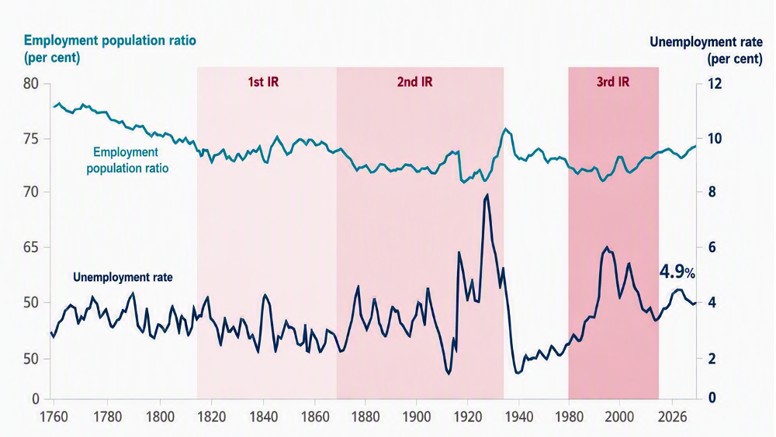
In all those periods of technological innovation, even as the economic shock affected many industrial sectors over time, economic change did not cause unemployment to rise over the long term or the employment ratio to fall (see chart 1).
To be clear, many current jobs were lost, but new roles emerged, so employment adjusts to the new driver of economic growth rather than collapses. However, the real issue is that we cannot predict winners and losers. That uncertainty is socially disruptive and potentially fraught, as the ‘dark satanic mills’ of the past show when farmworkers moved to cities to work in textile factories. Factory automation altered work but did not cause a long-term rise in unemployment. The electrification of industry in the late nineteenth and early twentieth centuries reshaped both manufacturing and the services sector, but employment levels stayed high. The extensive use of computing in the late twentieth century eliminated some clerical jobs but also created entirely new positions in IT, finance, communications, and professional services. The same pattern is likely today as AI is changing business models in real time. Yet job numbers remain high, and sectors with the most intensive AI use are growing rather than shrinking and they pay more, see chart 2.
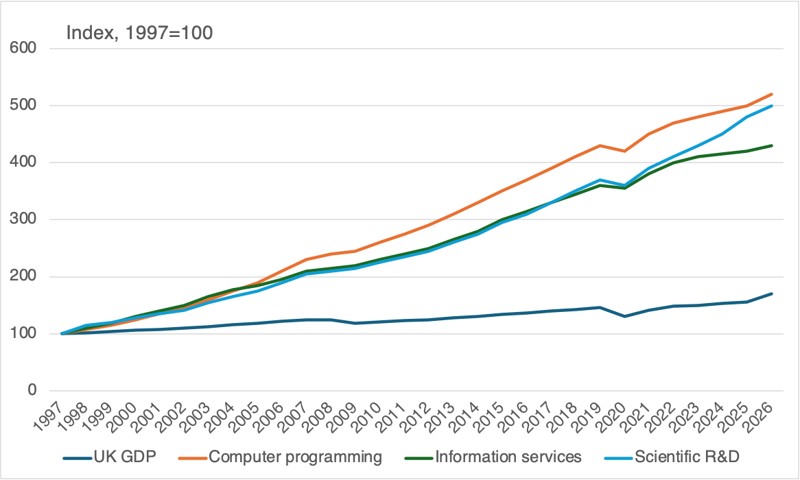
The sectors most closely linked with AI – namely computer programming, information services, and scientific research and development – are currently at the heart of the UK’s growth recovery.
Since 1997, the gap between AI-intensive sectors and total UK GDP has widened. Although UK GDP has grown steadily over the last twenty-five years, sectors linked to digital technologies and scientific innovation have expanded much faster, see chart 2. These sectors have consistently outperformed during the dot-com boom, the financial crisis, the post-2008 stagnation, the Pandemic shock, and the inflationary period of recent years.
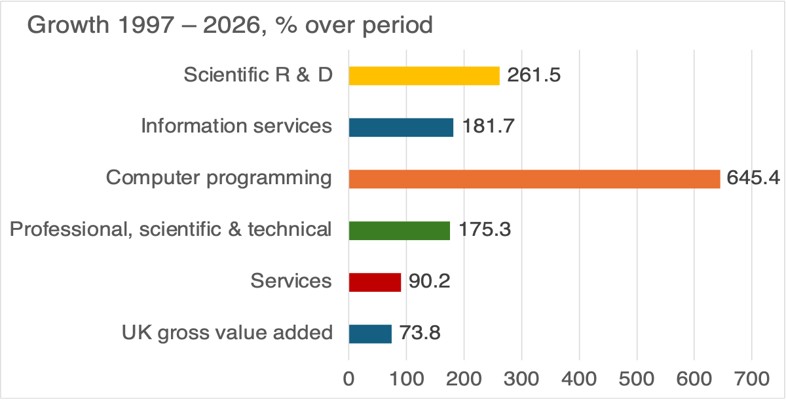
When whole-economy GDP growth (in the chart above it has expanded by 73.8% over the period 1997 to 2026 – latest data Q1) is set as 1, then computer programming has risen nearly 3× faster; information services by more than 2×. In other words, the most innovative parts of the UK economy are not only outperforming other sectors but also increasing their lead as digital capabilities, scientific knowledge, and data-centric business models spread across the economy, strengthening the thesis.
Another data dive shows that AI-intensive sectors’ salaries substantially exceed the UK pa median (from £27,600 in 2015 to £39,039 in 2025) over the last decade:
- software engineers: £40,000–£75,000
- data scientists: £45,000–£80,000
- cybersecurity roles: £48,000–£85,000
- information management: £35,000–£70,000
- scientific researchers: £38,000+, with senior roles above £60,000
It should be no surprise to see this outcome as higher wages reflect greater productivity and more demand for their skill set.
Support workers & firms in the transition
The UK’s productivity problem is often seen as intractable with no easy solutions. However, the recent evidence shows a more complex picture even at the headline level. In areas vital for future competitiveness – digital, data, research, and innovation – growth is in fact strong, as charts 2 and 3 shows. The key issue is making the transition as smooth as and non-disruptive as possible for the wider economy. To do this, attention should focus on traditional trades, with vocational training and the re-establishment of skills centres that previously taught them.
This might include government-backed retraining schemes, such as subsidised transition programmes for unemployed workers. For example, computer literacy or data analysis courses, short conversion courses for mid-career workers, and targeted reskilling funds can help people move from declining sectors to those growing rapidly. Career advice, job placement services, and wage subsidies for employers, along with R&D tax credits, expanded digital skills programmes, and investment incentives, could address this gap.
Measures like these would help increase the size and impact of high-productivity sectors. Evidence from the ONS, the OECD and the Bank of England supports this view: AI-intensive sectors have grown at double or triple the rate of the general economy and offer considerably higher wages, as do several other sectors where shortages of key workers are emerging.
A major reason is the long-standing preference for public funding of academic education over vocational and technical training, which has created an imbalance between academic and technical skills in the UK. To correct for this bias, future public spending on training and education should rebalance funding by increasing investment in vocational training and regenerating skills centres and technical colleges.
Conclusion
AI-intensive sectors are growing faster, are more innovative, and offer higher-paid jobs amid rising demand than other sectors. This follows a long-standing historical pattern where innovative technological advances disrupt existing industries while creating new opportunities. The main issue is the uncertainty about which sectors succeed or fail – there is no way of knowing in advance. Moreover, widespread AI adoption may increase regional inequalities and leave some communities behind as technology changes rapidly. To reduce these risks, and the factional politics it could entail, official policies must address regional inequalities by making targeted investments in slower-growing areas and expanding nationwide access to upskilling and reskilling. Businesses and households need time to adjust, as the benefits of the economic change the new technology brings will play out over decades rather than a few years.