

Ever since the end of the Second World War the United States has been the anchor of the global financial system. Its Treasury market is the deepest and most liquid in the world; the dollar remains the dominant reserve currency; and in moments of geopolitical stress, investors traditionally flee to US government debt. Yet that haven status is now being tested.
Fiscal excess, geopolitical overreach, and a chronic shortage of domestic savings are raising US bond market interest rates – slowly, but surely. Its centrality to the global financial system is earned by the crucial role it plays in being an anchor for global trade and profligacy will undermine that position.
US Debt crosses a psychological threshold
US federal debt has surged past $40 trillion (some 120% of its annual GDP), while interest payments alone are heading toward $1 trillion a year (see Chart 1), rivalling total defence spending – already the largest in the world and projected to rise toward $1.5 trillion over the next few years if current plans proceed. At the same time, the government is issuing debt not just to fund new programmes, but increasingly to pay interest on existing obligations. That is normally a classic sign of fiscal deterioration. Old debt is not being retired but rolled over, adding to the outstanding debt pile and increasing the refinancing burden.
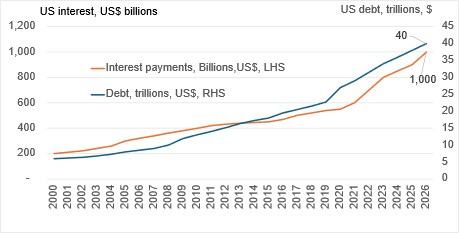
The pace of the deterioration is also accelerating. It took eight years for federal debt to rise from $10 trillion to $20 trillion. It then took six years to climb from $20 trillion to $30 trillion. But the jump from $30 trillion to $40 trillion has happened in just four years. In other words, the rate at which the US is accumulating debt is speeding up – and that acceleration means the US is demanding a greater share of the world’s savings so pushing up the interest rates its lenders demand.
War‑driven inflation is not helping
The Middle East conflict has pushed energy prices sharply higher, feeding expectations of persistent inflation. At the same time, defence spending is rising and supplemental appropriations for military operations are widening the deficit further. Higher inflation and higher borrowing feed directly into higher yields – and higher yields mean higher interest costs. The fiscal arithmetic worsens with every intensification of the crisis in the Middle East.
Weaponising the dollar while needing inflows
The US is increasingly using its financial system as a geopolitical weapon: freezing sovereign assets, sanctioning central banks, and threatening to exclude countries that it disagrees with from dollar‑based payment systems. This is creating increasing unease among foreign holders of US debt and a haven paradox.
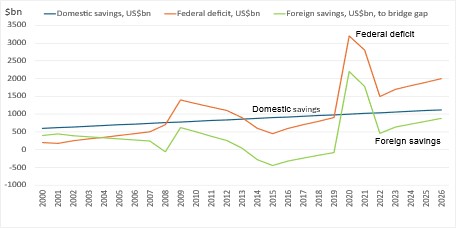
The US depends on foreign savings to fund its deficits. Domestic savings – by households and corporates – are simply not enough. The macro / accounting identity as it’s known is straightforward: domestic savings must equal domestic investment. When domestic savings fall short of domestic investment, the gap must be filled by an inflow of foreign savings.
As Chart 2 shows, the US has been borrowing from the rest of the world continuously for more than a decade, and at an accelerating pace, as domestic savings are exceeded by spending – driven above all by the expanding federal government deficit. That is the heart of the haven paradox: the US is the safest asset in the world because of the scale and dominance of its economy, but it needs foreign inflows because its own savings are insufficient to meet its spending so barriers to investing in the US will only reduce that flow and potentially create a crisis. That is why foreign lenders matter – and why antagonising them through tariffs, sanctions, or asset freezes is economically incoherent.
Trade wars with creditors?
The US is now in active or simmering trade conflicts with the very countries whose savings it needs: China, Europe, Mexico, Canada, India, and even the Gulf states. Tariffs erect barriers to trade so reduce export earnings and dollar inflows, making it harder for these economies to accumulate US Treasuries. It has threatened to use its status as a lender of last resort as a lever to dominate its geopolitical rivals and punish those that act out of line with its wishes, even in 3rd party relationships if the dollar is involved. As a result of increased risks from the weaponisation of the dollar’s status, some large foreign central banks are diversifying into gold, non‑dollar assets, and bilateral currency arrangements, as chart 3 shows.
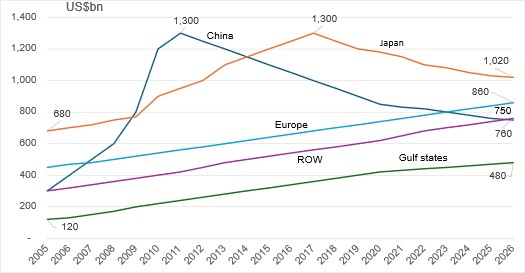
The larger the borrower and the greater its exposure to the US, the more it has reacted to political pressure by cutting US Treasury holdings. Recent political pressures have included trade tensions, threats of US-imposed sanctions, and disputes over technology and national security. China’s holdings peaked at around $1.3 trillion in the mid-2010s and have since fallen to just under $900 billion in the latest 2026 estimates. Japan shows a similar pattern: its holdings rose to around $1.3 trillion in 2019 before declining to just over $1 trillion today.
Meanwhile, Europe and the rest of the world have increased their holdings. The former now holds about $860 billion, and the rest of the world about $760 billion, putting both groups in a position to rival China and Japan as major holders of US debt. The Gulf states’ holdings have also increased, from around $120 billion in 2005 to $480 billion at present, although the rate of increase has slowed.
In summary, the traditional big lenders (and holders of the largest bilateral trade surpluses with the US) are reducing their exposure, while a broader, more diverse set of smaller lenders is filling the gap.
On the one hand, this diversification of US Treasury holders could spread risk more widely across the global financial system, making the market less reliant on the decisions of a few countries. On the other, it may also introduce new uncertainties, as a more fragmented base of lenders could react differently to changes in US economic policy or global market conditions. These shifts could make US debt markets and broader financial stability more unstable, so how these smaller holdings evolve matters more than ever.
Fiscal debt & monetisation
If foreign appetite for US debt continues to soften, the Treasury faces a stark choice: offer higher yields to attract buyers or rely on the Federal Reserve to absorb issuance. The latter is monetisation – the central bank effectively financing government deficits.
While monetisation does not necessarily imply hyperinflation, it does mean monetary policy becomes subordinate to fiscal needs. This is especially worrying if the monetary authorities are under the direct influence of the fiscal authorities. Even without explicit political pressure, however, a high debt burden can limit how far interest rates can rise, because doing so would make the debt unserviceable. The result is greater pressure on the central bank to act as buyer of last resort, making inflation risks more entrenched.
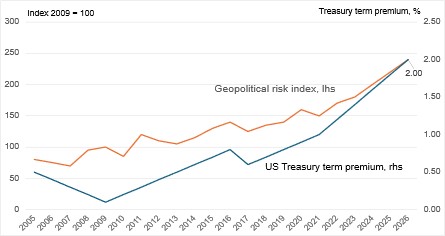
Meanwhile, geopolitical risk has risen sharply since the mid‑2010s, and the US Treasury term premium has moved up alongside it. The two series track each other closely, with both climbing to their highest levels by 2026. The chart suggests that higher geopolitical risk is increasingly associated with higher long‑term Treasury yields, reflecting a growing risk premium demanded by investors.
Conclusion – a slow‑burn crisis
To be clear, the US is not on the brink of default. The dollar remains strong; Treasuries are still liquid; and global investors continue to hold US assets. But the foundations of America’s safe‑haven status are weakening. A country that borrows heavily, saves little, weaponises its currency, and antagonises its creditors cannot assume that foreign demand for its debt will remain infinite.
Indeed, the bond market is signalling that the era of effortless US borrowing is ending. The price of that borrowing is rising – and a key question is how far it goes. Higher long‑term rates will inevitably affect US economic growth and investment. One thing is clear: higher costs for mortgages, credit cards and corporate loans will weaken US economic performance compared with a world in which the dollar had not been used so explicitly as a geopolitical lever. And that may even carry political consequences. One risk is that even traditionally loyal Gulf states begin to diversify their portfolios.