

Artificial Intelligence is attracting extraordinary levels of investment. Technology companies are spending hundreds of billions of dollars on data centres, semiconductors and computing capacity. Investors speculate about which firms will emerge as the dominant winners. Meanwhile, governments are developing national AI strategies and businesses are exploring what the technology might mean for their future.
Yet history suggests we may be asking the wrong question about AI. Finance theory tells us that not everyone can win. And the profits implied by today’s valuations cannot be realised simultaneously by every company competing in the sector.
Few people now remember many of the firms that drove the dot-com bubble. But they left behind a digital infrastructure and cheap assets for others to exploit. Railways left the United States with a continent-wide transport network that dramatically reduced the cost of moving goods and people, alongside numerous bankrupt railway companies. The whole economy often benefits long after investors have absorbed the losses. If Artificial Intelligence follows a similar path, the real long-term value is not in the invention; it is in the companies that adopt it and the value it creates for society.
Lessons from previous technological revolutions
Every major technological revolution generates excitement, investment and speculation. Investors understandably want to know who the winners will be. But economic history suggests that many of the firms that pioneer revolutionary technologies ultimately disappear, are absorbed into larger organisations, or fail to deliver the returns initially expected.
The railway boom of the nineteenth century left many investors out of pocket as railway companies competed and built too much capacity, resulting in periodic bankruptcies. But the railway network itself transformed economies as transport costs fell. Cheap travel across the US raised productivity across countless industries.
A similar pattern arose during the dot.com boom of the late 1990s. Many highly valued internet companies disappeared when the bubble burst. Yet the infrastructure that remained helped create today’s digital economy. Fibre-optic networks, data infrastructure and internet connectivity became the platform upon which entirely new industries were built. The whole economy commonly benefits long after investors have absorbed their losses.
This is why we should judge technological revolutions less by the firms that survive and more by the economic changes they leave behind. Productivity growth, higher wages and improving living standards are usually the most enduring legacies.
AI as a General-Purpose Technology
Economic historians frequently describe a small number of innovations as general purpose technologies (GPTs). The three most influential examples are generally considered to be steam power, electricity and computing, see table 1. Their importance comes from their ability to transform business efficiency and raise productivity across the entire economy, not just one sector.
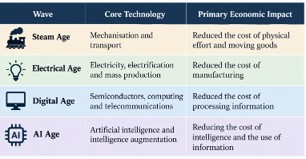
Artificial Intelligence appears to fall into that category because it can be widely adopted across a range of industries. Whereas earlier technological revolutions reduced the cost of physical labour, transportation and information processing, AI can reduce the cost of applying intelligence itself. Most economic activity involves analysing information, identifying patterns, making forecasts and making decisions. AI can assist with all these activities.
Examples abound. UK manufacturers are using AI-powered predictive maintenance to reduce downtime on factory lines, while logistics firms are optimising delivery routes through advanced machine learning. In healthcare, NHS organisations have been piloting AI systems to assist with diagnostic imaging, patient triage and medical research. Financial institutions are leveraging AI for fraud detection, customer analytics and operational efficiency. Retailers are deploying AI chatbots to improve customer service. Universities are experimenting with AI-based personalised learning platforms, while professional services firms are automating routine document review with AI tools.
If AI proves to be a genuine GPT, as many academics argue, its long-term impact could rival or even exceed previous technological revolutions because it spreads intelligence and lowers the costs of using it at the same time.
Diffusion Matters More Than Invention
The greatest gains from AI, therefore, are likely to come not from the firms creating the technology but from the thousands of organisations that adopt it. Historically, diffusion has often proved more important than invention itself.
Electricity transformed productivity when factories could access power wherever they were located rather than being tied to the source of their energy. Computers increased productivity only when businesses widely adopted them in their internal processes to improve efficiency and profitability. The internet transformed commerce only after millions of firms integrated digital tools into their operations, making online buying and selling commonplace.
Today’s AI investment boom is building the infrastructure that will enable similar future changes. Semiconductors, servers, data centres and computing power are the foundations on which broader economic benefits may eventually be built. But the gains tend to come later, when its many applications are developed as people figure out how to embed it in their business.
History suggests the key question is not just how sophisticated AI becomes, but how effectively businesses embed it in everyday operations. If the past is any guide, it will be very effective indeed. Such an outcome is sorely needed, as the UK has experienced weak productivity growth for much of the last two decades. Since the financial crisis, output per hour has increased by only around 0.5% a year, compared with roughly 2% a year before 2008. The result has been slow wage growth, stagnant household living standards and weaker economic growth.
Artificial Intelligence therefore arrives at a time when productivity growth is subdued, and labour force growth is slowing as the population ages. It could help businesses lower costs, improve efficiency and address one of the country’s most persistent constraints on economic growth.
The UK has rarely lacked innovation. The country possesses world-class universities, scientific institutions and research capability. The challenge has been translating innovation into widespread business adoption and stronger productivity growth.
Many innovations developed in one country ultimately generate their greatest economic benefits elsewhere through successful commercial adoption and widespread use. Adoption and application matter because they are what ultimately raise productivity, incomes and living standards.
The Role of SMEs
Discussion of AI often focuses on a handful of large technology companies. Yet AI’s future economic impact may depend far more on what happens within ordinary businesses. Manufacturers, retailers, logistics companies, accountancy firms, law firms, healthcare providers and small businesses collectively account for a much larger share of economic activity than technology firms alone. They also account for most UK business activity. Large corporations usually possess the resources needed to experiment with new technologies. Smaller firms often face greater barriers, including implementation costs, limited technical expertise, skills shortages and uncertainty about benefits.
On the one hand, SMEs face barriers such as implementation costs, skills shortages and uncertainty about returns, though practical experimentation and workforce training can help overcome them. On the other hand, small and medium-sized enterprises account for most UK businesses. If AI adoption remains concentrated among a relatively small number of large firms, the overall impact on national productivity growth may be limited. If it spreads successfully throughout the SME sector, the gains could be much larger.
An Ageing Population Raises the Stakes
Demographics provide another reason why AI matters. For decades, economic growth benefited from an expanding workforce. But the UK’s population is now ageing, and growth in the working-age population is expected to slow significantly over the coming decades. As a result, future economic growth will depend more on productivity gains than on workforce expansion.
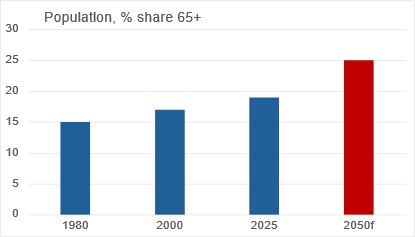
As the proportion of older people rises, fewer additional workers are available to support economic growth. That means each worker’s productivity becomes increasingly important. The Office for Budget Responsibility estimates that the UK’s projected demographic structure in 2075 would leave real GDP per person around 5% lower than under today’s demographic structure, even allowing for higher participation rates and longer working lives among older people. That finding highlights a fundamental challenge for the UK economy. As population ageing reduces the contribution that labour-force growth can make to economic growth, future improvements in living standards will depend increasingly on productivity growth.
In that context, AI may offer one of the few realistic ways of sustaining improvements in living standards as labour-force growth slows. Given the positive impact technological change has had on economic growth in the past, it should have a large impact on future growth.
Business Impact
For businesses, the priority should be adoption rather than waiting for perfect technology. Firms that begin experimenting with AI today are likely to develop valuable organisational knowledge before the technology becomes standard within their industries.
Those who learn how to use it effectively may be able to process information more quickly, analyse larger datasets and focus on higher-value activities. Success should not be evaluated solely by the number of AI start-ups created or patents registered. More important measures include adoption rates, productivity growth, wage growth and improvements in living standards. The objective should be widespread diffusion rather than technological prestige.
Conclusion
The discussion about Artificial Intelligence is often presented as being about technology. In truth, it is about productivity and how to increase output per unit of input. History suggests that the greatest benefits from general-purpose technologies do not come from their invention but from their widespread adoption across the economy. Railways, electricity and computing transformed business efficiency because they spread throughout the wider economy. Artificial Intelligence may follow a similar path. But the ultimate test of success will not be the fortunes of a handful of technology companies, however large they are. It will be whether AI raises productivity throughout the wider economy.
For a country facing weak productivity growth, sluggish improvements in living standards and an ageing population, the stakes could hardly be higher for the UK. The businesses and economies that prosper from AI will not necessarily be those that build the best models. Rather, they will be those that embed the technology most effectively across everyday economic, public, and private business activity. Now that AI has been invented, its business impact will depend on how effectively it is adopted in economies across the world.