Question everything


… economic insight that matters

Trevor offers you original insights from first principles and practical behaviourally-driven analysis backed by economic theory. In other words, he brings blue sky economic thinking to your issue.

Trevor cuts through the noise, demystifying economics. He has mastered the art of communicating the complex and making it understandable, whether through the written word or a presentation. And, with a network of contacts across academia and amongst professional economists, he’s at the cutting edge of economics today.

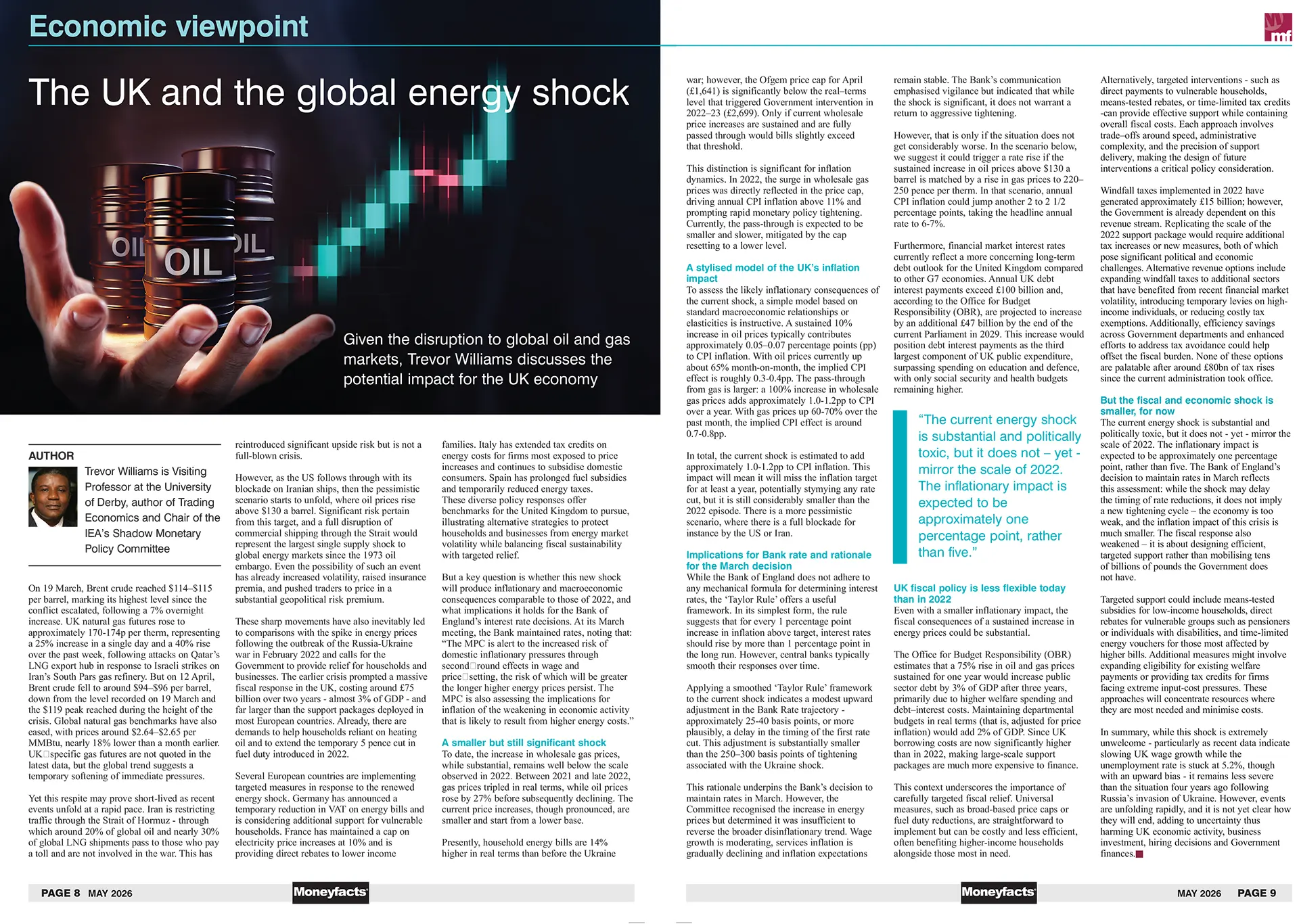
MoneyFacts – Improving forecasting models: Why fiscal forecasts matter and errors have real world consequences.

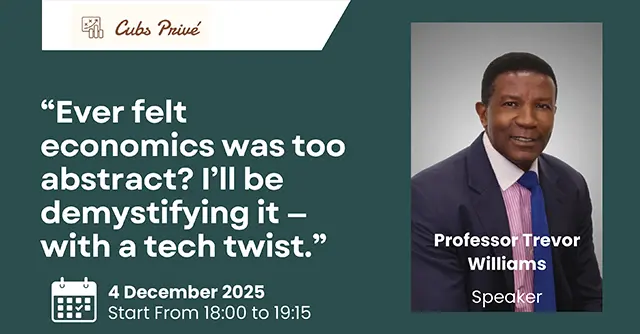
Cubs Privé - Thu 4 Dec 2025 6:00 PM - 7:15 PM IET, Savoy Place, WC2R 0BL
Book your place here!


About Trevor


Professor Trevor Williams

Trevor Williams is the former Chief Economist at Lloyds Bank Commercial Banking, a position he held for well over 10 years. During this time he established a highly-regarded, award-winning, team of economists analysing global and domestic data to support clients ranging from financial institutions, large corporates to SMEs with bespoke insight.

He is a visiting Professor at the University of Derby, rotating Chairman of the Institute of Economic Affairs Shadow Monetary Policy Committee (SMPC) and author of Trading Economics: A Guide to Economic Statistics for Practitioners (with Victoria Turton).

Trevor also lectures at CASS business school and Cardiff University. He is on the editorial board of Economia and the Journal of Corporate Treasury Management. He previously lectured in Economics and Business Statistics, before working in the UK Government Economic Service (GES). He sits on various charities, including as Patron of Reach Society, Chairman of Ballet Black, and Through the Looking Glass.

He regularly writes articles for publications, such as Moneyfacts, Clear Path Analysis, and Economia to name a few. He appears in the financial press and on television to discuss and comment on economic issues.

Trevor now runs a consultancy which specialises in economic analysis encompassing ‘big data’ – the large information set being created from the 4th industrial revolution sweeping the world – to better understand a fast changing global economy, and its political context: i.e. its political economy.

What We Do


Trevor is a well-known and highly-regarded speaker at many domestic UK and international business forums. He talks on a range of topics, including:

  • International trade
  • Economic forecasting
  • Financial markets
  • Trends in global financial markets
  • The future of the world economy
  • Globalisation
  • Demographics
  • Industrial trends
  • Productivity

Trevor has written and spoken extensively on how ‘big data’ can be used to analyse trends in macro-economic individual company performance and why and how the dramatic changes taking place in global financial markets are entirely understandable and predictable, even after the Great Financial Crisis. From this awareness, flows strategy and insight into the micro and macro-economic consequences of the evolution of the world economy for businesses and governments. What do some of these trends – some long, some short – mean for pensions, insurance, property markets, house builders, retailers or manufacturers?

  • Wondering what your company’s internal cost and sales data can tell you about how competitive your business is in the market place? Ask us, we can analyze the data, relate it to the market you operate in, and give insight into just how competitive you are and what you could do to become more so.
  • Do you have internal data that could give you information about trends in your trading environment before anyone else sees them? Ask us, and we can see if your data has leading indicator properties.
  • In the modern world, huge increases in computing power means that large amounts of data is being created that can help firms better understand the market they operate in and what, by their actions, their customers need and want from them.

Experience gained working at Lloyds Bank, and his economic knowledge, means Trevor is ideally placed to help you with that sort of analysis.

If you would like Trevor to speak at a forthcoming event or produce written insight, please contact us  to discuss your requirements.

Blog


UK Economic & Fiscal Outlook, November 2025 Budget: short-term relief v. long-term risk?

The Office for Budget Responsibility’s (OBR) November 2025 Economic and Fiscal Outlook offers a mixed picture of the UK’s economic outlook and fiscal challenges. On the surface, the numbers suggest stabilisation: growth has been revised up, fiscal headroom has doubled, and inflation is expected to ease back toward target. That should result in lower interest …

The £2,000 Pension Salary Sacrifice Cap: Fairness or a Blow to Savings?

When the Chancellor announced a £2,000 annual cap on salary sacrifice into pensions, it appeared as a minor adjustment. However, it could significantly influence the UK’s pension incentive structure, potentially altering saving behaviour, workplace culture, and long‑term capital markets, which warrants closer examination. A fiscal grab framed as fairness? Salary sacrifice has long been a …

Fiscal forecast errors part 2 – the political and financial implications

Following on from my last blog, which reviewed the history of poor fiscal forecasting in the UK and considered whether this was due to an overestimation of growth, or receipts, or an underestimation of spending or, indeed, all three, this blog looks at the effects of this persistent misstep. Political optimism vs Economic facts: The …

Speaking Events


Speaking Events

Summary takeaways from the Budget today so far

The £2,000 Pension Salary Sacrifice Cap: Fairness or a Blow to Savings?

When the Chancellor announced a £2,000 annual cap on salary sacrifice into pensions, it appeared as a minor adjustment. However, it could significantly influence the UK’s pension incentive structure, potentially altering saving behaviour, workplace culture, and long‑term capital markets, which warrants closer examination.

A fiscal grab framed as fairness?

Salary sacrifice has long been a tax‑efficient way for employees to boost pension contributions. By giving up part of their salary in exchange for employer pension payments, workers save not only on income tax but also on National Insurance. For higher earners, the savings could be substantial.

The new cap, effective from April 2029, restricts this advantage to the first £2,000 of sacrificed salary. For higher earners, this means they can no longer benefit from tax and NIC savings beyond that threshold, potentially reducing their overall incentives. Lower earners, who typically sacrifice less than £2,000, remain unaffected, which raises questions about the actual fairness and distribution of benefits across income groups.

Incentives Rebalanced — But at What Cost?

For lower earners, the incentive to save remains intact. They continue to enjoy tax relief and NIC savings on modest contributions, preserving pensions as the cornerstone of retirement planning.

For higher earners, however, the calculus changes. The cap removes the extra NIC advantage, reducing the appeal of salary sacrifice. Many may redirect savings into ISAs (lower now?), property, or other vehicles that offer greater flexibility. Employers, too, lose part of the incentive to promote salary sacrifice schemes, potentially weakening workplace pension culture.

The Treasury’s logic is to preserve incentives for mass participation while curbing disproportionate benefits at the top. However, a potential consequence is a decline in pension inflows, which could reduce long-term capital available for investments in equities and infrastructure, possibly affecting market stability and economic growth.

A deeper point is that the UK does not save enough and spends too much relative to its wealth, leading to a chronic current account deficit and reliance on foreign borrowing. This move to cap pension salary sacrifice further reduces savings, which could worsen the country’s fiscal challenges and impact long-term economic resilience. 

A Two‑Decade Tightening Cycle

This reform is not an isolated measure but part of a broader trajectory. Since the lifetime allowance was introduced in 2006, successive governments have narrowed pension reliefs for higher earners:

• 2006: Lifetime allowance set at £1.5m, later cut repeatedly.

• 2016: Annual allowance tapering introduced, reducing relief for incomes above £260,000.

• 2024: Lifetime allowance abolished, replaced by new lump sum limits.

• 2029: Salary sacrifice cap imposed.

The policy seeks to preserve incentives for lower earners while restricting them for higher earners to raise revenue. Each reform has been framed as fairer, but collectively they risk undermining pensions as a long‑term savings vehicle for those with the capacity to save more. The result has been the same: to raise more money.

Equity vs. Efficiency

The cap highlights a tension at the heart of pension policy. On the one hand, equity demands that tax reliefs do not disproportionately benefit the wealthy. On the other hand, efficiency requires strong incentives for all earners to save for retirement. By narrowing reliefs, the government may achieve Fairness, but at the cost of efficiency, discouraging higher earners from using pensions and reducing the capital available for long‑term investment.

The Bigger Picture

There was a fiscal hole to fill, and this is seen as one way to help fill it. Moreover, with the ‘triple lock’, pensioners have seen their income rise relative to other income groups over time. 

But this cap may also lead to a shift in savings behaviour. Pension funds could see reduced inflows, potentially changing asset allocation patterns. Future pensioners might save less, increasing the risk of poverty among retirees and raising social security costs, which highlights the importance of considering long-term social impacts in the debate.

Ultimately, the £2,000 cap is not just a technical adjustment but the latest chapter in a 20‑year tightening cycle. As much as any other item of fiscal policy, pensioners are not immune to the pressure put on the public purse.

Whether it proves to be a fair rebalance or a blow to savings will depend on how individuals, employers, and financial markets respond. I don’t think it will be positively.